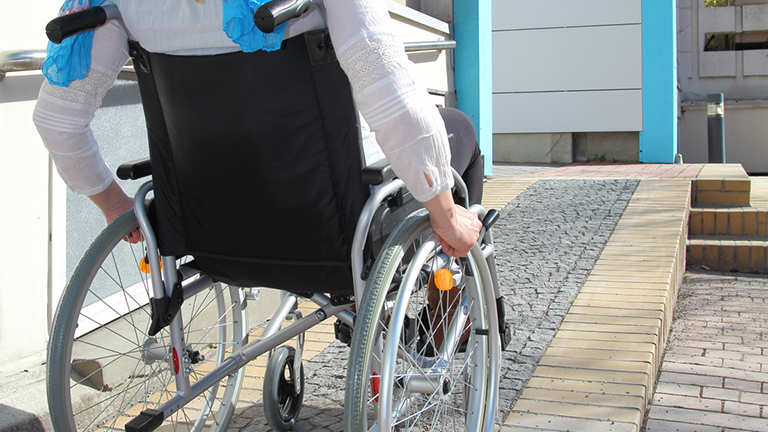
When a commercial building needs to be made accessible, the conversation usually comes down to two options: installing a wheelchair ramp or a wheelchair lift. Both meet accessibility requirements when designed correctly, but they solve very different problems.
For commercial spaces, the right choice is about more than just code compliance; space constraints, building layout, user traffic, and long-term usability all play a role. Here’s how ramps and lifts compare in real-world commercial applications.
Space Is Often the Deciding Factor
In commercial settings, space is valuable and often limited.
Ramps require significant horizontal space to meet the ADA slope requirement of 1:12. For even a modest change in elevation, a compliant ramp can extend a surprising distance. In urban buildings, storefronts, schools, or healthcare facilities, that space simply may not exist without impeding entrances, walkways, or affecting the flow of traffic at the site.
Lifts solve this problem by moving users vertically rather than horizontally. With a compact footprint (generally within 48” by 70”), lifts are often the preferred solution for tight entryways, raised lobbies, mezzanines, or stage access where a ramp would be impractical or disruptive.
If space is at a premium, lifts tend to offer a cleaner, more efficient solution.
Elevation and Building Layout Matter
Ramps are most effective for small elevation changes—such as a single step at an entry or an interior transition of less than 12 inches. As the height increases, ramps become longer, more complex, and harder to integrate into a commercial environment.
Lifts are designed to handle greater vertical rises and are commonly used to connect porches, decks, raised entrances, stages, and split-level interiors. For multi-step access points, a lift often provides safer, more direct access without extensive structural modifications.
In commercial projects, higher elevations typically point toward a lift rather than a ramp.
Upfront Cost vs. Overall Project Impact
Ramps are generally less expensive upfront, particularly for short, straightforward installations. They also require fewer mechanical components and no electrical connections.
Lifts usually involve higher initial costs due to equipment and installation requirements. However, in commercial projects where a ramp would need to be very long, heavily customized, or integrated into existing site constraints, a lift can reduce construction complexity and preserve usable space.
For many commercial projects, the decision isn’t about the lowest cost option— it’s about the solution that best fits the building without creating new problems.
Traffic Flow and User Experience
Commercial buildings serve users with a ride range of needs, not just mobility needs. Users may have health issues, such as heart complications, asthma, or arthritis, so you have to consider more than just those with mobility issues.
Ramps require users to travel a longer distance and may demand physical effort, especially in outdoor or high-traffic environments. They can also affect pedestrian flow when placed near main entrances. Any ramp with a rise greater than 18”- 24” may be difficult to use.
Lifts provide direct, push-button access that minimizes physical strain and keeps traffic moving efficiently. In facilities such as offices, schools, healthcare buildings, and public venues, lifts often offer a more predictable and user-friendly experience.
When accessibility needs to work seamlessly for many users throughout the day, lifts can offer a clear advantage.
Maintenance, Safety, and Reliability
Ramps are simple and durable but require attention in outdoor commercial settings. Snow, ice, rain, and debris can create safety concerns and increase maintenance demands.
Lifts require regular inspection and maintenance, but they also include built-in safety features. Some models come equipped for outdoor use but they can also be protected from the elements. In many commercial applications, this controlled environment helps ensure consistent, reliable access year-round.
Facility managers often weigh simplicity against reliability when making this choice.
Visual Impact and Building Design
A long ramp can significantly alter the appearance of a commercial building or site, especially at a main entrance. In addition, it may be difficult to find materials that match a property’s aesthetic, especially when doing renovations or remodels.
Lifts, with their smaller footprint, are easier to integrate into existing architecture and are often less visually intrusive. For projects where appearance, branding, or historic preservation matters, lifts may provide greater design flexibility.
Making the Right Choice for Your Project
There’s no one-size-fits-all answer when it comes to commercial accessibility.
Ramps are often a good fit for low rises with ample space and simple access needs. Lifts are typically better suited for limited space, higher elevations, and high-traffic commercial environments where efficiency and usability matter.
The best solution is the one that meets code requirements while also supporting the building’s layout, users, and long-term operations.